|
|

MENU
|
|
|
. |
|
. |
|
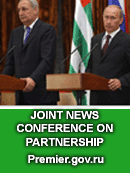
RUSSIAN PRIME MINISTER VLADIMIR PUTIN AND ABKHAZ PRESIDENT
SERGEI BAGAPSH ADDRESSED A JOINT NEWS CONFERENCE
Premier.gov.ru,
12.08.2009 |
 |
|
CC -
News Department |
|
. |
|
Transcript of
the joint news conference:
Sergei Bagapsh: I want to express my thanks to Russian
Prime Minister Vladimir Putin and other members of the Russian
Government for their visit to Abkhazia. We have discussed a
wide range of essential partnership issues at today's
restricted and extended attendance meetings. |
|
|
|
|
. |
Mr Putin's visit attests to the
dynamic development of mutually beneficial Russian-Abkhaz
relations. As you already know, we have signed another pivotal
bilateral agreement today. It envisages aid to Abkhazia to promote
its social and economic progress.
We are assured that the agreement will open new opportunities for
Abkhazia. Other agreements are being drafted. Mr Putin and I have
discussed them in detail today. We have come to a mutual
understanding on them.
I have said this to the Prime Minister and now I want to reiterate
it here: Abkhazia remains Russia's reliable ally in strategic and
other respects, especially considering its geography and, what
matters even more, its entire population's reverence for the great
power named Russia. Thank you.
Vladimir Putin: Mr Bagapsh,
ladies and gentlemen,
A year has past since the tragic events in the Caucasus. Much has
changed within that time. The recognition of Abkhaz and South
Ossetian independence became a natural event following the
aggression by the present Georgian regime. I say "natural" because
the Georgian authorities came to this result by themselves. They
began with the well-known decision to deprive their republics of
their rights to autonomy and in effect completed with their own
hands the collapse of Georgia's territorial integrity. They did
this themselves. This is the result of their own doing first and
foremost.
We are fully aware of the Abkhaz nation's striving for sovereignty
and independence. After last year's tragedy, Russia made the only
decision it could make-to recognise Abkhazia's sovereignty and
independence.
The situation has changed cardinally since then. Russia has made
its strategic choice, and there is no return to the situation of
previous years. Now we have other objectives standing before us-
the goal to develop the social and economic sphere of Abkhazia, a
country I am glad to be in today.
I want to once again thank the Abkhaz President for his
invitation.
We have drafted a plan for joint work in developing
infrastructure, tourism, transport, communications and the energy
industry. And of course, Russia is ready to offer what might be
figuratively called start-up capital. It will give Abkhazia the
opportunity to make the first steps independently, and strengthen
its economic and social basis.
No doubt, the Abkhaz people are a gifted, industrious and valiant
nation. They withstood a blockade and permanent warfare, whose
aftermath is felt even today, as reflected in the Gagra events.
They can certainly revive their economy with Russia recognising
their independence and determined to render them all-round
economic and political support and, if need be, military
assistance. The Abkhaz nation is of course in a position to
realise this goal.
I want to thank once again the Abkhaz leadership for their
invitation, as well as the public for their very warm and
hospitable welcome.
Thank you very much for your attention.
Question: Mr Bagapsh, only
a few countries have recognised Abkhaz independence within the
past year. What do you think of your nation's political future in
this context? Will it retain independence?
Also, if political recognition is in deadlock, it might be
worthwhile to take another road and promote economic recognition
through investors. What do you think?
My question to Mr Putin continues from the previous one. What else
can Russia do to promote the international recognition of
Abkhazia? Would you advise investors to buy in Abkhazia or take
their time? Thank you.
Sergei Bagapsh: Mr Putin, the
initial question is addressed to me, so I think I should start, if
you don't mind. A great power, the Russian Federation, has
recognised us, and it matters most. No country has ever been
recognised quickly and smoothly. Neither will Abkhazia be. To be
recognised soon does not matter so much as what your second
question concerns-a question I am grateful for: how soon will
Abkhazia achieve political and, even more important, economic
rejuvenation?
We need to create conditions and give an impetus for everyone to
see that Abkhazia is a genuine democratic, law-abiding state which
deserves to be accepted by the international community. It is our
duty to avoid errors during the emergence of Abkhaz statehood
because, by recognising us, Russia and other countries assume
obligations for our compliance with international conventions and
pledges to the world.
We have chosen a difficult path. We want to attract investments to
Abkhazia because no country can develop rapidly without them.
Abkhazia is integrating with Russia in a process that is gaining
pace. I approve such integration, and it will develop. Thank you.
Vladimir Putin: As for
reluctant recognition of Abkhazia, we never thought it would be
otherwise when we determined to recognise the sovereignty of
Abkhazia and South Ossetia. We proceeded from that point. Remember
who recognised Soviet Russia, and how long it took them to do so?
Real life will put everything in its place. If I may be frank,
Abkhazia needs only Russian recognition. As for Russian investors,
they of course should acquire all Abkhaz property. As for business
representatives from other countries, who are marking time, they
will come to the Abkhaz market later and buy at higher prices.
That is all there is to it.
Question: Caucasian
Television. I have a question addressed to both Mr Bagapsh and Mr
Putin. Prospects for stationing international observers in
Abkhazia have been discussed lately. How do you assess those
prospects? Do you think it would be worthwhile in the current
situation? Thank you.
Vladimir Putin: You know, I
have not followed the relevant negotiations very closely, but Mr
Bagapsh and I have discussed the problem just now. Abkhazia has no
objections to the presence of foreign observers representing the
most diverse international organisations, be it the United Nations
or OSCE. Abkhazia, a beautiful seaside country, is large enough to
receive them.
However, everyone should proceed from the available situation,
recognise Abkhazia as a sovereign state and international legal
entity, and conclude relevant agreements with it.
Sergei Bagapsh: I agree,
naturally. As you may know, we had no objections to the
establishment of a United Nations mission in Abkhazia. The time
has come now to recognise our independence and sovereignty instead
of basing relations with Abkhazia on old dogmas.
As for the European Union and the military observers you imply, we
can discuss the theme while only taking into consideration the
fact that they find themselves in an independent state, Abkhazia.
We are willing to enter negotiations on these terms. Thank you.
Source: Prime Minister of the Russian
Federation Web Site |
|
. |
|
. |
|

 |
|
|
|
. |
|
 |